
The exercises will be held after a gap of one year as both the sides were locked in a 73-day standoff in Doklam in the Sikkim sector of the border in 2017.

EAM Jaishankar's mission is aimed at strengthening India's strategic autonomy in a complex international environment, observes Ambassador M K Bhadrakumar.

Chinese media on Wednesday criticised the western media for attempting to drive a "wedge" between India and China.

Sun Weidong is an expert on South Asia who worked closely with external affairs minister S Jaishankar.

The report said that Indian officials believe China is trying to contain India by forcing it to divert more resources into defending simultaneously both its western border with Pakistan and eastern flank with China and by weakening its willingness and ability to challenge Chinese ambitions to dominate the region.

Unveiling a five-point formula to improve relations with India, China's newly elected President Xi Jinping on Tuesday said the resolution of the boundary dispute between the two sides "won't be easy" and pending its final settlement "peace and tranquility" should be maintained on the border without affecting the overall ties.

External Affairs Minister S Jaishankar on Wednesday took a critical view of some of the key decisions made by the Jawaharlal Nehru government, and said one needs to get out of this "cult worship" that the period from 1946 onwards was "great years" and the country did "splendidly".
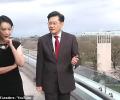
Qin, 57, was made the foreign minister in December last year, superseding many seniors, earning the distinction of a rising star in the ruling Communist Party of China.
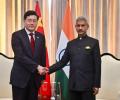
Qin's first in-person meeting with Jaishankar on Thursday came on the sidelines of the G20 foreign ministers conclave in New Delhi amid the over 34-month-long border row in eastern Ladakh.

Playing down its unsuccessful bid to establish diplomatic ties with Bhutan, China on Monday said it is glad to see New Delhi and Thimphu develop their relations further during the just-concluded visit of Prime Minister Narendra Modi.

India and China have agreed to maintain peace and tranquillity in the border areas which was a "pre-requisite" for continued growth of bilateral relations as also to enhance cooperation in key areas, including counter-terrorism, maritime security and civil nuclear energy sector.
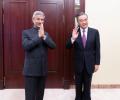
According to Jaishankar, much has changed, mostly to India's disadvantage, since November 1950, when Sardar Patel and Jawaharlal Nehru had a famous exchange of views on how to approach China.
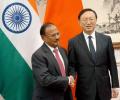
The decision was taken during the annual 19th round of boundary talks in Beijing between National Security Advisor Ajit Doval and his Chinese counterpart Yang Jiechi.

The official told the reporters during a conference call on Friday, ahead of the next week's 2+2 India-US Ministerial in New Delhi, that the Trump administration was providing support to India through defence sales, joint military exercises and information sharing.

The PM will meet Mongolian President Tsakhiagiin Elbegdorj on his first ever visit to the country.

We have seen great strides in all-around cooperation, Chinese foreign ministry spokesperson said.

United States needs to successfully manage its relationship with emerging powers like India and China, Secretary of State Hillary Clinton has said and insisted that the Obama administration's shift of military, diplomatic and commercial assets to Asia is not to "contain" Beijing.

The relations between India and China cannot be normal if peace and tranquillity in border areas are disturbed, External Affairs Minister S Jaishankar said on Friday.
'China-India relations are now in the best shape in history. Bilateral ties have entered a new stage of comprehensive development and neither side views the other as a threat.'
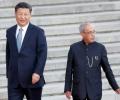
In his 50 years in politics, he made positive contributions to China-India relations, Chinese Foreign Ministry spokesperson Hua Chunying said.

The last round of Corps Commander-level talks had taken place on October 12 but there was no breakthrough on the disengagement of troops from the friction points.

Seeking to enhance cooperation with India, China's new Premier Li Keqiang told Prime Minister Manmohan Singh that Beijing would like to promote strategic cooperation and partnership with New Delhi to a "new stage".

The discussions took place on the sidelines of the G20 Foreign Ministers' Meeting.

After India firmly told China that its violation of the border pacts has "eroded" the entire basis of bilateral ties, China's defence ministry on Friday said the situation at the border is "generally stable" and both sides should put the boundary issue in an "appropriate position" and promote its transition to "normalised management".

Outlining eight "pillars" for the future of India-China relations, President Pranab Mukherjee on Wednesday underlined the need for comprehensively resolving challenges including the boundary question through "political acumen" and "civilisational wisdom".

The scaling up of the India-US strategic partnership to the level of non-NATO ally with defence deals, sharing and transfer of defence technology, interoperability, joint collaboration and joint production of defence equipment has exacerbated Moscow's anxiety, notes Rup Narayan Das.

In his farewell remarks posted on the Chinese embassy website, Sun said it is only natural for important neighbours China and India to have some differences but the key is how to handle the differences.
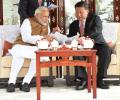
"The two leaders have also mapped out concrete measures to implement such kind of consensus," she said.

It is for China to decide what role it plays at the G20 summit in New Delhi, a top US official has said, asserting that if Beijing wants to come in and be a "spoiler", that option is available to it.

'The Modi visit will prove to be the watershed where India and the United States commenced technology trade and transfer.'
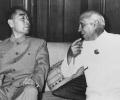
'The war of 1962 exposed the hollow intellectual foundations of Nehruvian foreign policy, especially vis-a-vis China and that is why it was such a shock.'

'Having India as a credible deterrent vis-a-vis Chinese ambitions in the Indian Ocean and South Asian region is a desirable short-term outcome.'
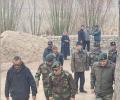
India and China agreed during their military talks on Sunday to stay in close touch and work out a mutually acceptable solution to the "remaining issues" in eastern Ladakh at the earliest, but there was no indication of clear forward movement in ending their three-year-long border standoff.

There is enough scope for India and China to cooperate on nuclear energy issues despite the lingering issues which not only includes the Sino-Pakistan nexus, but also the Sino-India border dispute over the LAC, says Debalina Ghoshal.

The bilateral relations have maintained sound momentum of growth, thanks to the mutual visits of the leaders by the two countries, Chinese foreign ministry said.
Defence ministers of India and China on Tuesday began their delegation-level talks, during which the two sides are expected to take a decision on resuming military exercises stalled since 2010. During the talks with Defence Minister A K Antony, General Liang Guanglie, who is the first Chinese defence minister to visit India in eight years, is expected to address New Delhi's concerns over Chinese military infrastructure build-up along the border.
Foreign policy is always a work in progress and ups and downs are built into foreign policy process. What is permanent is national interest. Hopefully, this year, which will also witness general elections in the country, will also clear clouds in the foreign policy horizon, observes Rup Narayan Das.

Sticking to its stand that McMahon Line on India-China boundary is "illegal", China on Monday said it is ready to work with India to resolve the vexed border issue at an early date through "friendly consultations" to create more favourable conditions for bilateral ties.
